Shehuo
Chinese carnival-like folk celebration during Spring Festival.
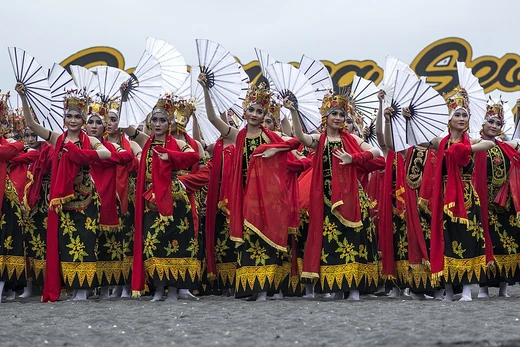
Shehuo (Chinese: 社火; pinyin: Shèhuǒ; lit. 'community fire'), also known as earth and fire, is a Chinese traditional carnival-like folk celebration prevailing mainly in the countryside of Northern China during the Chinese New Year. It features dragon dance, lion dance, Yangko dance, traditional Chinese opera, stilt walkers, fire breathing, drumming and other folk arts, and encompasses hundreds of character figures including deities, immortals, buddhas, sages, heroes, and mythical creatures. Rooted in primitive sacrificial activities where ancient people prayed for harvest and affluence, Shehuo has been inscribed on China's National Intangible Cultural Heritage list since 2006.
- Origin
- Qin and Han dynasties (about 2,000 years ago)
- Type
- Folk celebration
- Region
- Northern China (especially Shaanxi, Qinghai, Gansu, Shanxi, Liaoning, Xinjiang)
- Nationality
- Chinese
- Known for
- Community fire festival with dragon dance, lion dance, stilt walkers, opera, and masks
- Heritage status
- China's National Intangible Cultural Heritage (2006)
Lore & Background
Shehuo traces its history back to ancient sacrificial ceremonies held to pray for good harvests about 2,000 years ago. Known as Saishe in early Chinese texts, it originated from an ancient community ritual called Chunqi Qiubao ('spring prayer and autumn thanksgiving'), which developed from the earlier 'Three Big Sacrifices': the rain-seeking ritual of yu, the year-end thanksgiving ritual of zha/la, and the exorcism ritual of nuo. The first Shehuo event dates back to the Qin and Han dynasties, combining 'Hundred Dramas' with acrobatics in sacrifices to the Earth God and the Valley God, and was also known as 'Shooting Tiger'. It gradually evolved into an entertainment activity to welcome the Spring Festival, further developed in the Tang and Song dynasties, and flourished in the Ming and Qing dynasties. Starting from the late Qing and Republican eras, Shehuo increasingly incorporated elements of regional opera, folk dance, and Buddhist ritual gestures, resulting in rich cultural syncretism.
Reader's Guide
Shehuo holds significance as a living folk tradition that preserves ancient sacrificial and exorcism rituals while adapting over two millennia. Its two major types—Pose Shehuo (including Cloth, Carrying, Horse, Car, Xinzi, Mountain, and Masked forms) and Performance Shehuo (Floor and Stilt-walking)—showcase character displays, craftsmanship, and martial arts-style combat inspired by myths, legends, and historical stories such as Romance of the Three Kingdoms, The Investiture of the Gods, and Journey to the West. Regional variations reflect local history and ethnic diversity: Shanxi's Shehuo flourished due to Ming-Qing merchant prosperity; Shaanxi's Blood Shehuo features violent stunt makeup passed only through male lineage; Qinghai incorporates Hui traditions; Gansu absorbed Silk Road and multi-ethnic elements; Xinjiang blends minority arts; and Benxi Shehuo in Liaoning may originate from Shaanxi or Manchu shamanism. Shehuo masks, especially painted wooden ladle masks called Mashao facial makeup, are hung on doors to ward off evil. In 2026, a traditional Shehuo performance in Haidong, Qinghai, was recognized by Guinness World Records as the 'largest Shehuo performance'.
Did You Know?
- Shehuo was inscribed into China's National Intangible Cultural Heritage list in 2006.
- In 2026, a Shehuo performance in Haidong, Qinghai, was recognized by Guinness World Records as the 'largest Shehuo performance'.
- Shehuo masks known as Mashao facial makeup are painted wooden ladles hung on doors to protect houses and ward off evil.
- The stunt skill of Shaanxi's Blood Shehuo is 'only passed on to sons but not daughters'.
More in Ritual 1-24
Spotted an error? Know more?
This is a living reference — every entry is fact-audited, and reader corrections feed straight into our audit queue. Suggest an edit · See this site's audit record